If your Indianapolis home shows new stucco cracks or suspicious staining after a storm, you’re likely weighing stucco repair vs replace. The right choice depends on what’s happening behind the surface. RoofPros approaches stucco, EIFS, and re-siding projects with a planning-first assessment so you can compare clear options—minimal patching, full-plane refinishing, or complete remediation/re-siding—before you commit.
Stucco repair vs. replace in Indianapolis: how to decide
Not all “stucco” is the same. In Central Indiana you’ll encounter:
- Hardcoat stucco (traditional): A cement-lime-sand plaster over lath. It can crack with movement, show efflorescence, and absorb then release moisture. It tolerates our climate when detailed with a drainage path.
- EIFS (synthetic): Foam insulation board with mesh and acrylic coatings. Early systems often lacked a drainage plane; trapped water can lead to soft spots, rot at sheathing, and delamination.
These systems fail differently in Midwest weather:
- Freeze-thaw cycles widen small cracks and drive water into the wall, especially on north/east elevations and shaded areas.
- Wind-driven rain and missing kick-out flashing at roof-to-wall intersections concentrate water at windows, doors, and eaves.
- Clay-heavy soils around Indianapolis can cause minor settlement, showing as step or diagonal cracking.
Use this simple triage:
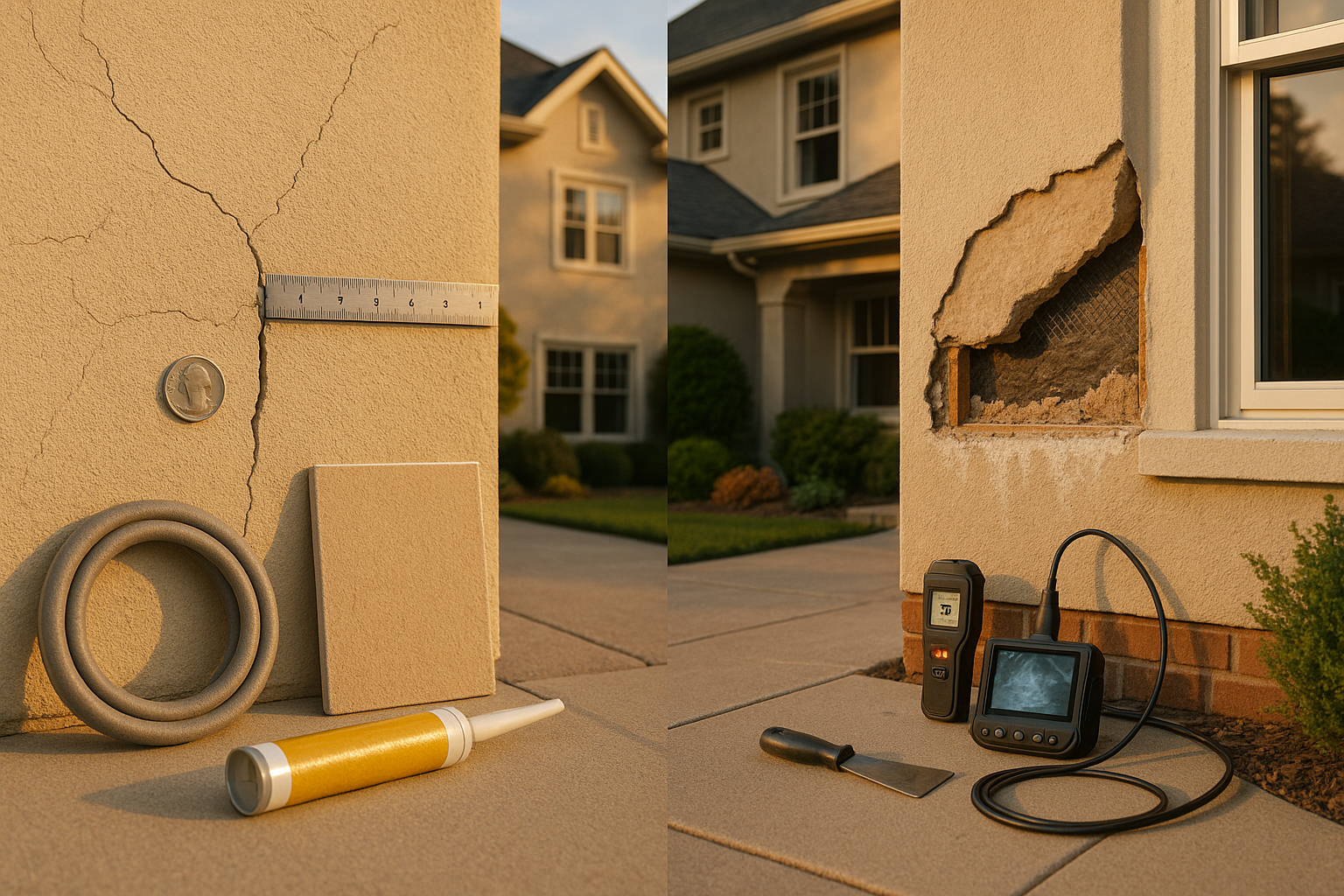
Repair usually fits when: - Hairline cracks (shrinkage) under ~1/16 inch - Isolated impact damage with firm, solid substrate - Flashings/gutters are working; no musty odor or interior staining - Lath, WRB, and sheathing test dry and sound
Replace or remediate when you see: - Widespread staining, soft spots, bulging/delamination, or hollow sounds - Moisture readings above safe ranges; musty odor indoors - Repeated patch failures or extensive structural cracks - EIFS without a drainage plane, missing weep screed, or buried base-of-wall details - Failing window/door or roof-to-wall flashings allowing chronic intrusion
When targeted repair makes sense (and how to do it right)
Typical repair scenarios
- Hairline shrinkage cracks and limited corner/stucco crack repair in Indianapolis neighborhoods with older hardcoat facades
- Isolated impact dings near hose bibs or along driveways
- Localized sealant failure at penetrations where the wall assembly behind is still dry and intact
Repair methods that last
- Evaluate first: Probe moisture at suspect areas; confirm lath and sheathing are solid. If readings are normal and the assembly is intact, proceed.
- Prepare the crack: V-groove wider cracks; for joints, add backer rod and high-grade, paintable sealant compatible with stucco.
- Patch and retexture: Use a cementitious repair material for hardcoat or system-approved base/finish for EIFS. Feather the texture into surrounding areas.
- Color/texture blending: Expect some variation on older walls. For a more uniform appearance across a facade, consider an elastomeric coating after repairs—applied only once drainage details are confirmed.
What elastomeric coatings are (and aren’t): They can bridge micro-cracks and create a consistent sheen. They are not a solution for hidden moisture and should never be used to “seal” an undrained system.
Seasonality: can you repair stucco in winter?
Yes, with planning. Many products require temperatures above roughly 40°F during placement and cure. In cold months, temporary tenting and gentle heat can maintain a proper curing environment. Most Indianapolis homeowners prefer spring or fall windows for predictable weather, but urgent repairs can proceed in winter with the right setup.
When replacement or remediation is the safer investment
Red flags that point to replacement
- Bulging and delamination, soft substrate, or rotten sheathing
- Efflorescence streaks and recurring wet spots below windows despite prior caulking
- Missing drainage details: no weep screed, stucco below grade, or EIFS without a drainage plane
- Chronic leak points at roof-to-wall transitions without kick-out flashing
Smarter assemblies for long-term durability
- Drained hardcoat stucco: Two-layer WRB, properly fastened lath, control joints, a continuous drainage plane, head flashings, and a code-compliant weep screed with ground clearance.
- Re-siding with a ventilated rainscreen: Fiber cement or engineered wood installed over furring creates a capillary break for faster drying and easier future service. “Fiber cement over stucco” can be feasible when the stucco is structurally sound—furring must be anchored to framing, penetrations properly flashed, and clearances maintained. If the stucco or sheathing is compromised, a full tear-off to the studs may be required.
Cost and timeline factors (no surprises)
- Extent of hidden damage and sheathing replacement
- Elevation complexity and access (steep grades, tall gables, chimneys)
- Architectural details (bands, half-timbering on Tudors, curved profiles)
- Texture/color matching versus full-plane refinishing or re-siding scope
- Coatings/paint scope after repairs
- Weather windows for curing; winter tenting/heat if needed
- City/township permits and possible HOA design approvals
- Protection of landscaping and hardscape
RoofPros documents these items up front so you understand allowances, contingencies, and lead times before work starts.
Indianapolis weather realities and the details that prevent repeat problems
Freeze-thaw, humidity, and wind-driven rain magnify small mistakes. The following details are non-negotiable for stucco maintenance in Indiana:
- Continuous drainage plane and two-layer WRB behind stucco or EIFS drainage mats
- Properly fastened metal lath and well-placed control joints
- Backer rod + high-grade sealant at penetrations (lights, hose bibs, vents)
- Weep screed at the base with correct clearance above grade or paving
- Head flashings over openings and kick-out flashing at roof-to-wall transitions
- Clean, correctly sized gutters/downspouts that move water away from the wall and foundation
For more on water management above the wall, see our piece on why well-designed gutters protect exteriors and roofs: /blog/why-gutters-matter-roof-longevity/.
RoofPros’ planning-first stucco assessment
We start with investigation—then we recommend repair or replacement with a clear scope.
- Moisture probing: Pin and impedance checks at high-risk locations
- Infrared screening (when conditions allow) to map potential wet zones
- Borescope checks at penetrations and window perimeters
- Flashing review: Windows, doors, transitions, and roof-to-wall tie-ins
- Photo-documented findings and a written plan with side-by-side repair vs. replace paths, including itemized pricing and schedule targets
If your stucco concerns started after a storm, you may also find this guide helpful: /blog/indianapolis-storm-damage-roofing-guide/. And for a broader look at exterior upkeep timing, review our homeowner inspection pointers here: /blog/roof-inspection-checklist-homeowners/.
Aesthetics and resale: set expectations early
Even expert patches can read differently on older, sun-faded finishes. Options to consider:
- Color/texture match repair: Best for smaller areas; expect subtle variation
- Full-plane refinishing: Uniform look across a large wall or entire elevation
- Re-siding: Clean, consistent appearance and simpler disclosures if moisture was remediated
Many buyers in neighborhoods like Meridian-Kessler, Broad Ripple, Irvington, and 1990s–2000s subdivisions in Carmel, Fishers, and Zionsville appreciate documented remediation. Your RoofPros package includes photos and moisture readings that support future disclosures.
FAQs: straight answers for Indy homeowners
How do I know if my stucco needs repair or full replacement?
If cracks are small and the substrate tests dry and solid, targeted repair works. If you find soft spots, widespread staining, bulging, or elevated moisture, plan for remediation or re-siding.
What’s the difference between EIFS and hardcoat stucco?
Hardcoat is cement-based over lath and can shed and release moisture if detailed to drain. EIFS is synthetic over foam; early “barrier” EIFS without a drainage plane can trap water and damage sheathing.
Will elastomeric paint fix moisture problems behind stucco?
No. Elastomeric coatings can unify appearance and bridge hairline cracks, but they don’t correct missing drainage, flashings, or wet sheathing—and can mask issues if used prematurely.
Can you match the color and texture on older Indianapolis homes?
We can blend closely, but sun exposure and age affect color. For seamless curb appeal, many owners choose full-plane refinishing or re-siding on key elevations.
Can new siding be installed over existing stucco?
Sometimes. If stucco and sheathing are sound, fiber cement or engineered wood can be installed over furring to create a ventilated rainscreen. If there’s rot or delamination, remove to framing and rebuild.
You can’t do stucco work in winter, right?
You can—with tenting and gentle heat to maintain cure temps. Expect longer cure times and careful scheduling.
Will insurance cover stucco remediation if moisture is found?
Coverage varies. Sudden, accidental damage may qualify; long-term intrusion often doesn’t. RoofPros provides detailed documentation to support your conversation with your insurer.
My house is part brick, part stucco—can you still repair correctly?
Yes. Transitions require through-wall flashing, proper sealant joints, and correct weep details so both materials manage water independently.
Do I need to move out or remove landscaping?
No move-out. We protect nearby plantings and hardscape; some trimming may be needed for access and to maintain base-of-wall clearances.
Next steps: a clear plan, not guesswork
If you’re comparing stucco repair or replacement, start with certainty. RoofPros will evaluate moisture, verify drainage and flashing details, and deliver a written, photo-rich plan outlining the repair-vs-replace path, cost factors, and timeline. Prefer to bundle exterior updates? Get a Free Deck Consultation and we’ll discuss coordination and scheduling during the same planning call.
Ready for a clean, premium result tailored to your home? Request your Indianapolis exterior assessment here: /#quote. For more local insights, explore our latest posts at /blog/.
Ready for a free roof assessment?
We climb the roof, photograph the damage, and give you an honest read — no pressure, no upsell.