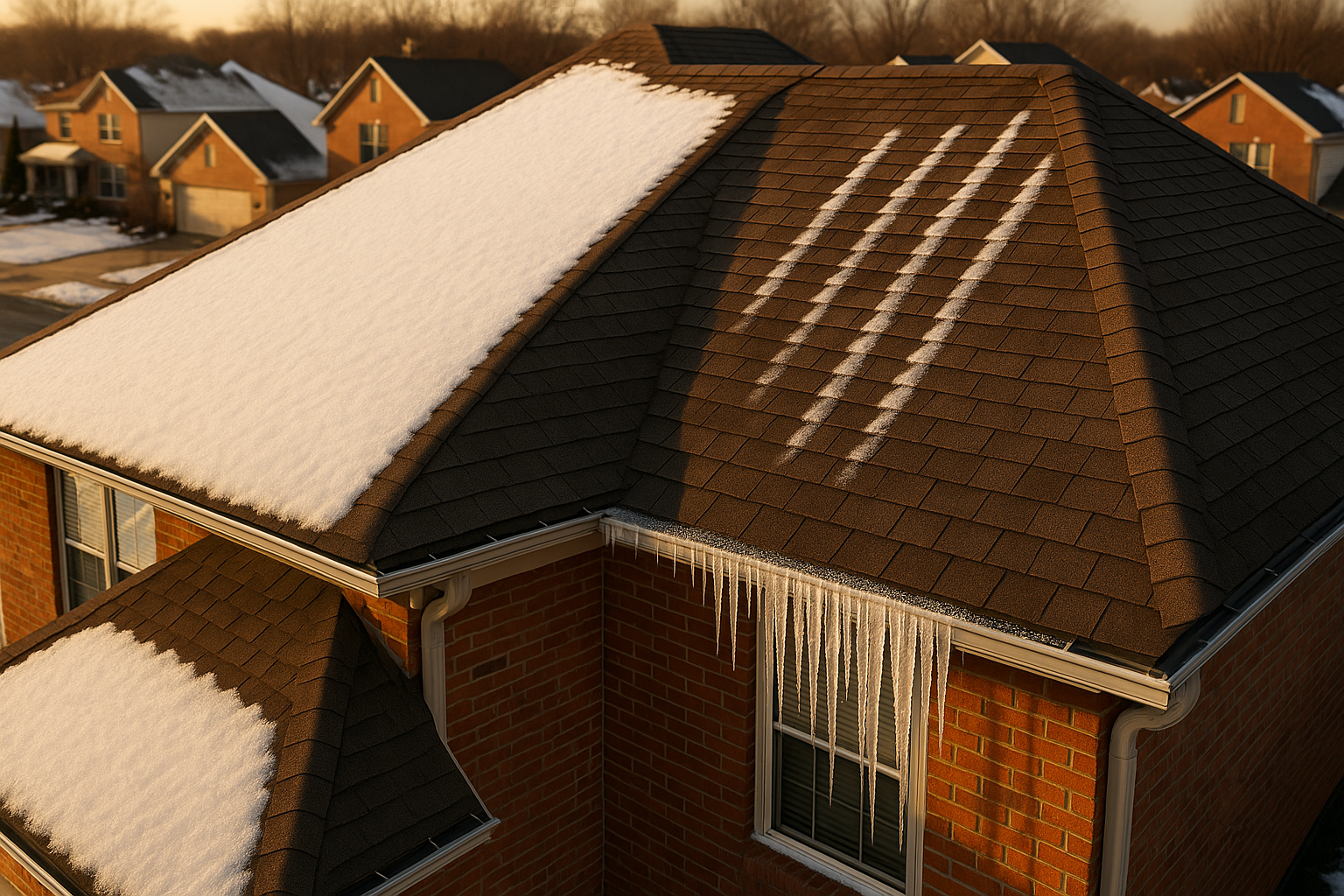
Water has one job on your home: get off the roof and away from the structure. In Central Indiana, where heavy downpours, leaf-heavy falls, and freeze–thaw winters are routine, well-designed gutters aren’t optional trim—they’re part of the roof. At RoofPros, we plan roof and gutter systems together so water doesn’t wick under the eaves, rot fascia, stain soffits, or sneak into wall assemblies.
Gutters are part of the roof system—not an accessory
A roof moves water down slope. Gutters complete the job by catching that water at the edge and sending it away from the home. When gutters are undersized, clogged, or poorly pitched, they overflow. Overflow at the eaves forces water back under shingles, accelerates shingle-edge wear, and can start leaks at the very place most vulnerable to wind-driven rain: the lower courses.
What that looks like on an Indianapolis home: - Moisture wicking behind the drip edge leading to fascia and soffit rot - Granule “wash lines” near the eaves as water sheets over the edge - Staining on soffits and peeling paint on fascia from chronic wetting - Splashback that saturates lower-roof sections and landscaping
The roof and gutter system must act as one: properly integrated drip edge that overhangs into the gutter, correct gutter pitch, adequate downspout capacity, and kick-out flashing at roof-to-wall transitions to divert water away from siding.
What Indianapolis weather does to eaves
Central Indiana brings quick-hitting thunderstorms, gusty winds, and winters that yo-yo around freezing. Those conditions punish roof edges and gutters.
Ice dams and snowmelt in Indiana
Freeze–thaw cycles create rims of ice at the eaves. If gutters and downspouts are blocked, meltwater has nowhere to go, so it refreezes, builds icicles, and forces water backward under shingles at the cold edge. Properly sized, clean gutters and clear downspouts reduce standing water and help limit ice buildup at the eaves.
Short, intense downpours
Our summer storms can dump an inch of rain in minutes. On two-story homes in Carmel, Fishers, Zionsville, Westfield, Greenwood, Avon, and across Indy’s older neighborhoods like Meridian-Kessler, Broad Ripple, and Irvington, that water volume can overwhelm 5-inch gutters. Upsizing and increasing downspout capacity keeps water in the trough instead of over the edge.
Wind-driven rain and hail
Strong gusts can push rain up under the shingle edge and dent or misalign gutters. After big systems pass, add gutter checks to your seasonal roof inspection routine (fasteners, seams, outlets, and elbows). If a storm dings gutters, dents downspouts, or tears sections, document it alongside roof impacts to streamline any insurance conversations. See our local guide: /blog/indianapolis-storm-damage-roofing-guide/.
Right-sizing and designing your roof-and-gutter system
Good drainage is design, not guesswork. RoofPros starts with roof area, slope, valley convergence, and where upper roofs dump onto lower sections.
6-inch vs 5-inch gutters in the Midwest
- 5-inch K-style: Fine for smaller, single-story runs with modest roof area.
- 6-inch K-style: A better match for many two-story homes and large planes common in Indy suburbs. The larger trough and 3x4-inch downspouts move more water during short, intense storms, reducing overflow.
Rule of thumb: As roof area and pitch increase—or when multiple planes converge into one run—jump to 6-inch gutters and larger downspouts.
Downspout count, placement, and extensions
- Add outlets at logical low points to avoid long dead-end runs.
- Place downspouts to break up heavy inflow from valleys or upper roofs.
- Use 3x4-inch downspouts on 6-inch gutters and at long runs.
- Extend discharge several feet from the foundation to protect basements and prevent splashback onto lower roof sections—especially important in our clay-heavy soils.
Pitch, hanger spacing, and integrations
- Gutter pitch: Subtle but consistent. Too flat invites standing water; too steep looks wrong and reduces intake under heavy rain.
- Hanger spacing: Tighten spacing on steep two-story homes and wind-prone exposures to prevent sagging and pull-out.
- Drip edge and gutter integration: Drip edge should direct water into the gutter, not behind it. Underlayment should extend correctly at the eaves.
- Kick-out flashing: Where a roof meets a wall, kick-out flashing keeps water out of the cladding and away from windows and trim.
Materials and guard options that actually work
Quality materials and hardware pay back over decades.
- Seamless aluminum or steel: Fewer joints mean fewer leak points. Aluminum resists corrosion; steel adds rigidity for long runs.
- Hidden hangers with screws: Stronger and cleaner than spike-and-ferrule; better in wind and under snow load.
- Corrosion-resistant fasteners and sturdy outlets/elbows: Small parts that make a big difference in service life.
Gutter guards: pros and cons
- Micro-mesh guards keep out most leaves and seed pods while preserving water intake; they pair well with snow and ice when pitched correctly.
- Solid-cover systems shed leaves well but can overshoot water in cloudbursts if the nose isn’t tuned to your roof pitch.
- Any guard reduces debris but doesn’t eliminate maintenance. Plan to check and rinse as part of spring/fall care, especially after maple helicopters in spring and oak leaves in late fall.
If you have few trees, guards can still help with seed pods and roof grit—but we’ll weigh cost vs. cleaning frequency during an assessment.
Maintenance rhythm for Indy homes
A practical schedule keeps water moving and protects warranties that expect proper drainage.
- Late fall: Clean after leaf drop and check for sagging, leaks, and fascia staining.
- Spring: Rinse out maple helicopters and shingle grit; ensure downspouts run clear.
- After major storms: Look for dented sections, loose hangers, and misaligned outlets.
- Two-story access: Don’t risk steep pitches or high eaves; many homeowners opt for professional cleaning and inspection on upper levels.
For a structured approach, use our seasonal checklist: /blog/roof-inspection-checklist-homeowners/.
Signs your gutters are hurting your roof
Call for a check if you notice: - Shingle granule wash lines or premature wear near the eaves - Peeling paint on fascia or staining on soffits - Mulch erosion under roof edges or standing water by the foundation - Frequent icicles or icy sidewalks below eaves in winter - A roof leak at eaves that appears after heavy, wind-driven rain
Coordinate roof and gutter projects for a clean result
Reroofing is the ideal time to evaluate gutter capacity and condition. Sequencing matters: drip edge, underlayment, and gutters should tie together cleanly to avoid capillary leaks. A well-designed drainage plan also supports manufacturer warranty conditions about proper water management. For what warranties typically include (and don’t), see: /blog/roof-warranty-guide-whats-actually-covered/.
If storms have damaged both roof and gutters, documenting everything in one visit can simplify next steps with your carrier. Start with a combined inspection so the scope is clear.
Straight answers to common Indianapolis questions
Do gutters really affect how long a roof lasts?
Yes. When gutters overflow, water repeatedly wets the shingle edges, fascia, and soffits. That accelerates edge wear and can void protections that assume proper drainage.
How often should Indianapolis homeowners clean gutters?
At least twice a year: late fall and spring. Add a check after major storms or if you’re near mature trees in neighborhoods like Meridian-Kessler, Broad Ripple, or Irvington.
Are 6-inch gutters worth it for Midwest storms?
On larger or two-story homes, often yes. They pair with larger downspouts to reduce overflow during short, intense rains.
Will gutter guards stop ice dams?
No guard stops ice dams by itself. Good attic insulation/ventilation plus clear, right-sized gutters reduce ice at the eaves. Guards help keep water pathways open.
What signs show my gutters are causing roof leaks?
Look for eave-only leaks after heavy rain, soffit staining, or granule lines at the edge. These point to overflow or water getting behind the drip edge.
Should I replace gutters when I replace the roof?
If current gutters are undersized, corroded, or poorly integrated, reroofing is the best time to update capacity and connections.
How far should downspouts discharge from the house?
Several feet, ideally to a splash block or buried extension that moves water away from foundations and prevents splashback onto lower roofs.
What’s the best gutter material for Indianapolis homes?
Seamless aluminum is the most common value choice; steel adds rigidity for longer runs or high-exposure sides. Both need quality fasteners and hangers.
Can hail or wind-damaged gutters be part of an insurance claim?
Sometimes. Dents, tears, or pulled sections can be documented alongside roof impacts. Learn what to photograph and note here: /blog/indianapolis-storm-damage-roofing-guide/.
How do drip edge and gutters work together?
Drip edge directs water into the gutter and keeps it off the fascia. Proper overlap and alignment prevent capillary action from pulling water behind the gutter.
How RoofPros plans and quotes gutter work
We’re a specialist, planning-first roofing company rooted in Indianapolis. Our assessment clarifies scope before any work begins: - Measure contributing roof areas and map valleys and dump points - Evaluate 5-inch vs. 6-inch capacity, downspout count, and locations - Check pitch, hanger spacing, and fastener condition - Confirm drip edge, underlayment terminations, and kick-out flashing - Discuss guard profiles that balance debris control with water intake - Provide an itemized, plain-English quote with materials and expected outcomes
You’ll know exactly what you’re getting and why it fits our local conditions. Clean communication, premium materials, and careful craftsmanship—that’s the RoofPros approach.
Ready to protect your roof and foundation?
Schedule a no-pressure roof-and-gutter assessment and receive a clear, itemized plan for your home. We’ll size the system for Indy’s storms, integrate it cleanly with your roof, and outline maintenance that keeps everything flowing. Get a Free Deck Consultation. Start here: /#quote.
Prefer more background first? Explore our homeowner resources: - What an inspection should cover: /blog/roof-inspection-checklist-homeowners/ - Understand coverage limits before you need them: /blog/roof-warranty-guide-whats-actually-covered/
Ready for a free roof assessment?
We climb the roof, photograph the damage, and give you an honest read — no pressure, no upsell.