Last March, a buddy in Broad Ripple called me in a panic. He had a dinner-plate-sized water stain on his living room ceiling, right under the upstairs bathroom. He was sure a pipe had burst. But when I climbed into his attic, the plumbing was bone dry. The trail of dampness on the roof decking led us to the opposite side of the house—a cracked pipe boot gasket around a plumbing vent, nearly 20 feet away. That’s when he learned the first rule of leak hunting: water travels. The wet spot on your ceiling almost never lines up with the hole in your roof.
Now, if you’re staring at a fresh stain or a drip after an Indiana thunderstorm, you’re probably wondering: how to find a roof leak before it turns into a bigger mess. Let’s walk through it step by step, from the attic to the gutters, with some Hoosier-specific wisdom thrown in.
Start in the Attic (After You Grab a Flashlight)
Safety first. If your roof is steep, two stories up, icy, or you’re just not comfortable on a ladder, stay on the ground. Use binoculars. Call a pro. No shame. But if you can safely get into your attic, that’s where the real detective work begins.
Grab a bright flashlight and head up there during the day. Look for the wettest spot on the ceiling from below, then try to find that same area in the attic. Water travels along rafters and sheathing, so scan uphill from the stain. You’re hunting for dark streaks on the wood, rusted nail tips (nails that look like they’re sweating orange), damp or moldy insulation, and—most telling—pinpricks of daylight where none should be. Even a tiny gap around a pipe vent or a nail pop can let gallons in over time.
While you’re up there, rule out any non-roof gremlins. If you see a plumbing line or an AC condensate drain right above the stain, and the roof decking is dry, your problem might be mechanical. I’ve seen homeowners spend hundreds on roof patches only to find a cracked toilet drain. Check simple things first. If the attic is dry but the stain keeps growing when it hasn’t rained, it’s likely a plumbing or HVAC issue—a classic roof leak vs plumbing leak case.
Common Leak Villains in Indianapolis Homes
Once you’ve spotted the trail in the attic, connect the dots to the outside. Around here, certain troublemakers show up again and again.
Wind-driven rain is a big one. Those spring storms that slam Indy sideways can push water under shingles that were fine in a vertical downpour. If your leak only happens when it’s blowing hard, check for lifted shingles and loose flashing first.
Pipe boot failures are sneaky. The rubber gasket around your plumbing vent pipes gets brittle from sun and freeze-thaw cycles—classic Indiana weather—and cracks into a split that sends water straight down the pipe. From below, it looks like a plumbing leak, but the wet trail usually starts at the boot.
Chimney flashing takes a beating here, especially in older neighborhoods like Meridian-Kessler or Irvington where brick chimneys with aging mortar are common. Wind can wiggle the step flashing loose, and water creeps in along the edges. If your stain is near a chimney, that’s suspect number one. (For a deeper dive, check out our post on chimney flashing repair in Indianapolis.)
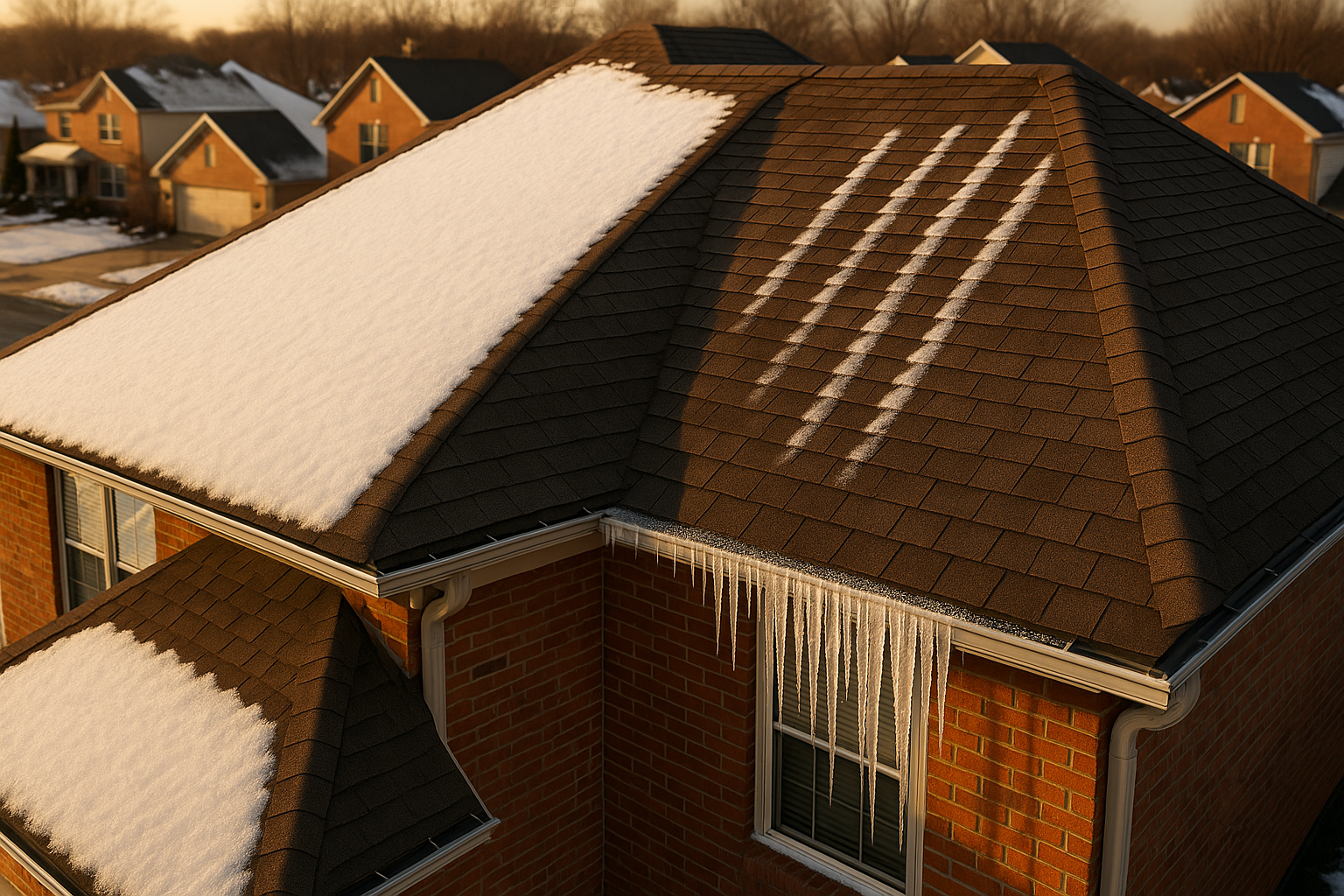
Ice dams—those sneaky ridges of ice at the eaves in winter—force melting snow back under shingles. It’s especially bad on north-facing slopes and in well-insulated attics where heat escapes and refreezes. After a harsh freeze-thaw cycle, you might see water stains in exterior walls or along ceilings right where the roof meets the wall.
Clogged gutters are another classic. Mature oaks and maples (we’ve got plenty) drop leaves and helicopter seeds that plug up downspouts. When gutters overflow, water can back up under the shingles or seep behind the fascia and into soffits. I’ve seen soffit and fascia water damage that looked like a roof leak but was purely gutter neglect. If it rains and water drips behind your gutters, you’ve got a gutter overflow leak.
Other spots: roof valleys packed with debris, skylight seals dried up, ridge vents with missing fasteners, and hail-dinged shingles from a storm last April that you forgot about. Hail damage doesn’t always leave a hole, but it can knock off granules and crack the mat, letting water seep in slowly. If you’ve had a recent hailstorm, check for roof decking rot before it spreads.
The Dry-Day Hose Test (For the Truly Dedicated)
If you’ve narrowed it down but can’t pin the exact entry point, a hose test can help—but I only recommend this if your roof is walkable and you’ve got a helper. Never climb on a wet, steep, or two-story roof.
Pick a dry day. One person stays in the attic with a cell phone and a bright light focused on the suspicious area. The other person gently sprays water on the roof, starting low and moving upward section by section. Wet one small spot for 3–5 minutes before moving higher. The moment water appears inside, you’ve found the leak zone. Don’t spray upward under shingles—that’s cheating and you’ll create false leaks.
I’ve seen this method pinpoint a leak to a single nail hole in a valley pan where the sealant had dried out. But I’ve also seen guys slip and break an ankle. If you’re not 100% sure, skip it and call us.
When to Put Down the Ladder and Call for Backup
Some leaks are beyond the DIY radar. If the leak only happens during wind-driven rain, it’s a flashing or shingle lap issue that might need a pro’s eye. If you see soft or blackened roof decking in the attic, you’re past caulk—that’s rot from long-term moisture and likely needs replacement. Chimney and wall flashing repairs are tricky because water often enters at the intersection of materials and travels sideways. And if you’ve got multiple stains or a sagging ceiling, that’s an emergency.
Homeowners sometimes ask me: “Can I just caulk it?” Occasionally, yes—for a tiny nail-pop. But if you’re squeezing silicone into a 6-inch split in a pipe boot, you’re buying weeks, not years. And that’s assuming you even found the real source. A lot of folks chase stains with sealant only to have the leak pop up three feet over.
Also: don’t wait. Small stains spread to roof decking rot faster than you’d think, and once the decking goes, you’re into structural territory. If you need to buy time, put a bucket under the drip, carefully poke a hole in any ceiling bulge to release trapped water (prevents a collapse), and get a tarp on the area if rain is coming. We offer emergency roof tarping for just that scenario—no judgment, just a dry house.
The Local Advantage: Why an Indianapolis Pro Makes a Difference
Every leak has a story, but here in Indy, the plot usually involves our specific weather quirks. Freeze-thaw cycles force water into hairline cracks. Spring storms with sideways rain expose shoddy flashing. And those gorgeous mature trees that shade our neighborhoods also dump enough leaves to choke a gutter system twice a year.
A local roofer (yes, like us at RoofPros) knows that a leak in a Carmel home with a steep gable and original 1980s flashing needs a different approach than a leak in a Plainfield ranch with architectural shingles. We’re familiar with the permitting dance too—for smaller repairs you usually don’t need a permit, but if decking replacement or structural work crops up, you might. We handle that.
If you’re tired of chasing stains or just want a second set of eyes, grab your phone, snap some photos of the stain and the attic, and then request a leak assessment. We’ll show up with ladders, a bright light, and a plan—no guesswork, no pressure. You’ll get a clear scope with pictures, material specs (upgraded flashing, ice-and-water shield where needed), and a straightforward cost breakdown.
Spring is prime leak-discovery season, so the schedule fills up. But the earlier you catch it, the less damage piles up. In the meantime, keep those gutters clean (we’ve got a handy guide for that) and pencil in a spring roof check before the next big thunderhead rolls in.
Ready for a free roof assessment?
We climb the roof, photograph the damage, and give you an honest read — no pressure, no upsell.